

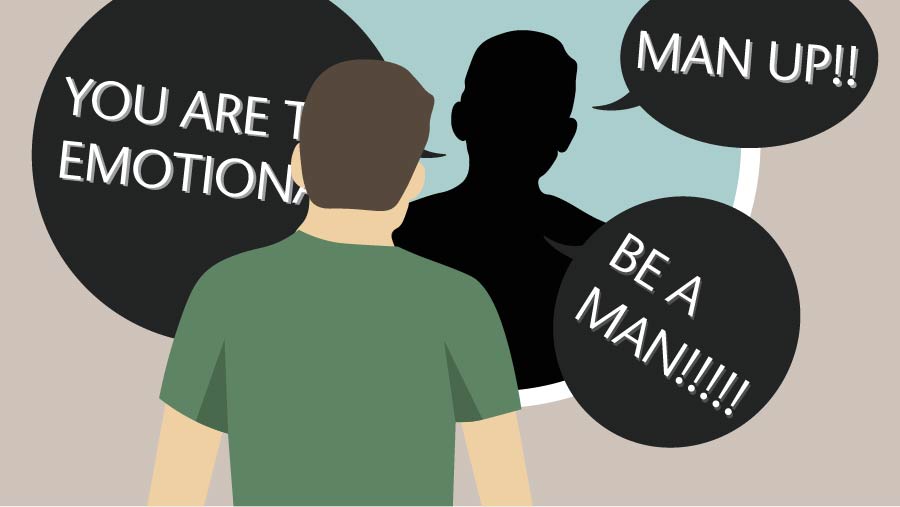
The Story Men are Told to Live
Men’s mental health is often discussed as if the main issue is that men “just won’t talk.” But that framing misses what research and clinical work keep pointing to: many men can talk, many men do feel deeply, and many men want support. The barrier is more often the set of stereotypes and social rules they have learned to live by.
Across many cultures, men are still implicitly trained to be the steady one, the provider, the problem-solver, the person who keeps it together. The script is familiar: be tough, don’t complain, don’t burden anyone, push through, go to work, act normal, handle it privately. Psychological research has long described how norms like self-reliance and restrictive emotionality can shape whether and how men seek help, and why the “I should be able to handle this” belief becomes a powerful trap rather than a strength.
What Distress Actually Looks Like
As a therapist, I see how these stereotypes show up in the room, not as abstract ideas, but as lived patterns. Many men do not arrive saying, “I’m experiencing depression.” They arrive with sleep problems, burnout, conflict at home, irritability, a short fuse, or a sense of numbness and disconnection.
They may describe feeling like a pressure cooker, always one small thing away from snapping, and then feeling ashamed that they “lost it.” Research supports this mismatch between how emotional distress is expected to look and how it often presents in men.
A growing body of work describes “externalizing” expressions of psychological distress, including anger, irritability, risk-taking, avoidance, and substance use, which can mask underlying depressive symptoms and delay recognition by the individual, their family, and even professionals when we rely too narrowly on classic symptom descriptions.
The Problem with the “Strong, Silent Man”
This is one reason the global stereotype of the “strong, silent man” can be so harmful. It doesn’t only discourage help-seeking. It can also distort self-understanding.
If a man believes significant emotional struggle is supposed to look like visible sadness or tearfulness, he may not recognize his own difficulties when they show up as anger, emotional shutdown, overwork, or increased alcohol use.
When distress is misread as a character issue (“I’m just angry,” “I’m just stressed,” “I’m just not good at emotions”), shame grows, relationships strain, and the window for early support shrinks. Research examining masculinity and help-seeking consistently shows that conformity to traditional masculine norms influences how men interpret their internal experiences and whether they seek professional support.
The Actual Cost
The cost of these stereotypes is not theoretical. It shows up in outcomes. In Canada, men account for a disproportionately high number of suicide deaths, a pattern that has remained consistent over time. Ontario is not separate from this reality.
Clinically, the key point is not to label this as a “men’s issue” in a simplistic way, but to recognize that many men are living with intense internal distress while also being socially rewarded for appearing composed and capable.
When someone’s identity is built around being dependable, it can feel humiliating to admit they are struggling. That humiliation is not a personal flaw. It is often the predictable result of gender role strain and the social expectations placed on men.
Strength vs. Endurance
Research also highlights that “being tough” is not the same as being well. Endurance can help someone survive difficult periods, but when it becomes the only acceptable stance, it can interfere with recovery and emotional processing.
Qualitative studies with Canadian men experiencing significant psychological distress and suicidality describe profound internal suffering alongside strong pressures to cope alone and maintain control.
This aligns closely with what many clinicians observe: men often seek therapy at the point where their usual coping strategies stop working, not because they lacked insight earlier, but because the perceived social cost of asking for help felt too high until circumstances forced change.
A Better Way to Understand and Support
From a therapist’s lens, the most helpful shift is replacing stereotype-based assumptions with a more accurate and compassionate clinical frame. Instead of asking, “Why won’t he talk?” we can ask, “What has talking cost him in the past?”
Instead of assuming emotional restraint reflects limited emotional depth, we can understand it as a learned protective strategy that once served an important function.
Effective therapy with men does not require forcing vulnerability or positioning masculinity as the problem. It tends to work best when it is collaborative, respectful, and grounded in practical understanding, while still making room for fear, grief, uncertainty, and tenderness at a pace that feels safe.
The goal is not to remove strength, but to expand it so that resilience includes self-awareness, support, and sustainable coping, not only endurance.
References
Addis, M. E., & Mahalik, J. R. (2003). Men, masculinity, and the contexts of help seeking. American Psychologist, 58(1), 5–14.
Seidler, Z. E., et al. (2016). The role of masculinity in men’s help-seeking for psychological distress: A systematic review.
American Psychological Association. (2018). Guidelines for Psychological Practice with Boys and Men.
Courtenay, W. H. (2000). Constructions of masculinity and their influence on men’s well-being. Social Science & Medicine, 50(10), 1385–1401.
Oliffe, J. L., et al. (2012). Men’s experiences of emotional distress and suicidality in Canada. Social Science & Medicine, 74(4), 506–514.
Public Health Agency of Canada. Suicide in Canada: Key Statistics.